AI Courses after 12th in India (2026): Top 5 Options, curriculum, Job Opportunities
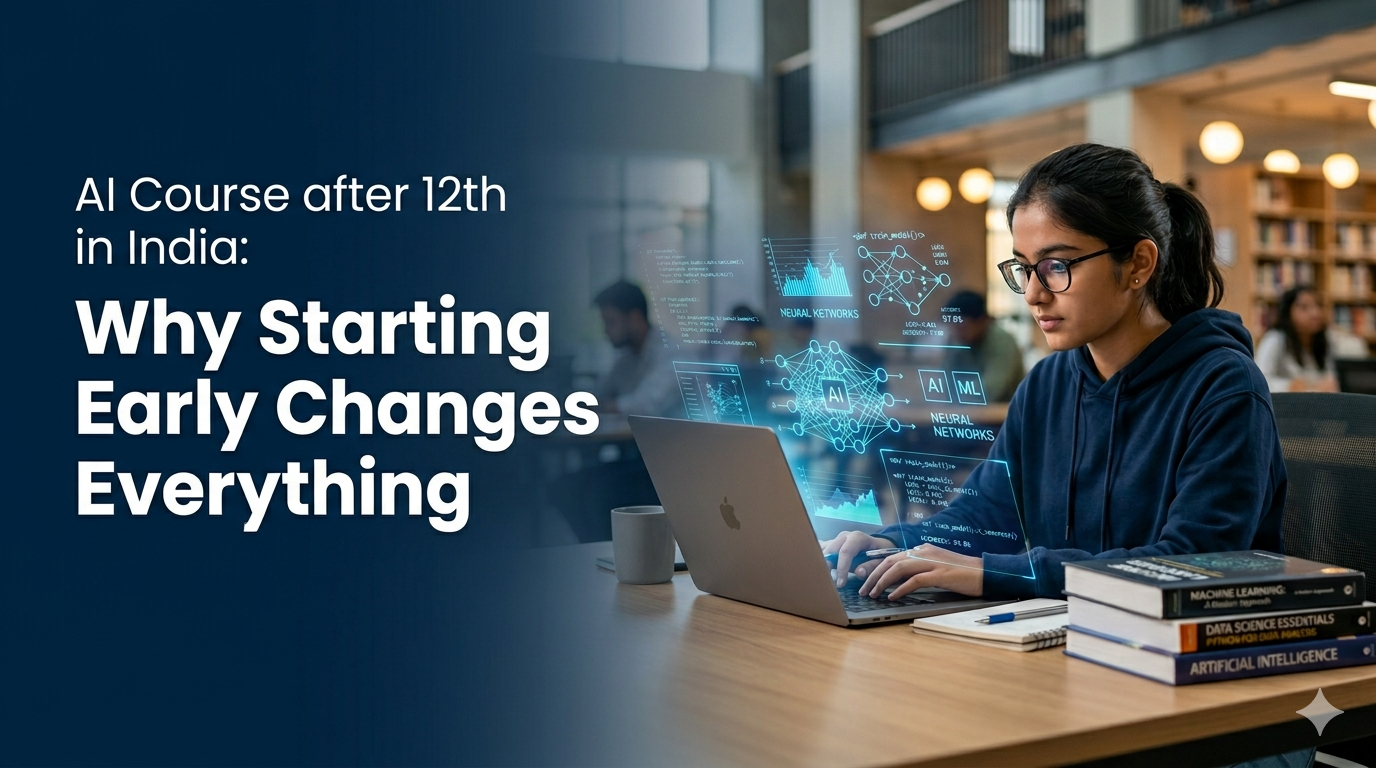
Discover why pursuing an AI course after 12th in India gives students a head start — more time to build skills, gain experience, and lead in a fast-growing field.
Nobody warns you about how overwhelming this decision actually gets. You finish Class 12, boards are done, and suddenly everyone — relatives, teachers, that one uncle at every family gathering — has an opinion on what you should study next. If you’ve already decided AI is where you want to go, the noise gets worse, not better. Every college claims to have a “state-of-the-art AI lab.” Every online platform insists their twelve-week certificate will make you “industry-ready.”
Here’s what none of them say: choosing the right AI course after 12th in India matters far less than what you bring into it. The students who struggle aren’t usually the ones who picked the wrong college. They’re the ones who showed up with no real foundation and discovered, about six weeks in, that the maths is harder than expected and everyone else seems to have a head start they can’t account for.
That head start is real. And it didn’t happen by accident.
This guide covers the main paths available after 12th — degrees, diplomas, certifications — and what you’re likely to encounter in each. But it also covers the part most guides quietly skip: what separates students who thrive from those who spend two years playing catch-up.
Your Real Options After 12th: Degree, Diploma, or What?
Three broad paths. Very different outcomes depending on who you are and what you actually want.
Undergraduate Degrees (3–4 Years)
B.Tech in AI & Machine Learning is the long game. Four years of serious engineering — real Maths, real programming, and a curriculum that takes you from writing basic Python to understanding how a neural network actually works under the hood. Government colleges want JEE Main. Private universities have their own tests. PCM in Class 12 is the baseline, usually at 50–60% minimum. If you’re committed to a technical career in AI, this is still the most respected path.
B.Sc. in AI or Data Science sits one step down in intensity but not in value. Three years, stronger emphasis on theory and analytics, and a better fit if you’re drawn toward research, business intelligence, or the data side of things rather than core engineering. BCA with an AI specialisation covers similar ground but leans more toward software.
Commerce and Arts students get written out of these conversations more than they should. BBA in Business Analytics and BCA in AI & ML are legitimate options that don’t require a Science background — and they’re becoming more relevant as AI seeps into finance, marketing, HR, and logistics. One caveat worth being honest about: you will hit statistics and quantitative reasoning at some point in any AI-related programme. There’s no version of this field that’s entirely maths-free.
Diploma Programmes (1–2 Years)
Faster, cheaper, and more narrowly focused on skills the job market will immediately recognise. Worth considering if you want to start earning while still learning, or if you’re adding a qualification on top of something else. The limitation is real though — senior technical roles nearly always need a degree eventually. Diploma holders and degree holders aren’t competing for the same jobs five years in.
Online Certification Courses
These get oversold. A certification from a reputed international platform is a genuine asset — as a supplement to a degree, not instead of one. In the Indian job market, a standalone certificate without a degree behind it carries limited weight when it comes to structured hiring at established companies. That said, for plugging specific gaps in your knowledge or demonstrating initiative to a recruiter, they’re worth doing. Just go in with clear expectations.
What You’re Actually Going to Study
Across most AI courses in India — regardless of what the degree is called — the curriculum follows a fairly consistent arc. Here’s what you’re walking into:
• Mathematics. Linear algebra, probability, statistics, calculus. This is the part that trips people up most often. Students who haven’t worked through Maths seriously at school level tend to hit a wall in the first semester. It’s not impossible to recover from, but it’s a painful way to start.
• Programming. Python is the language of the industry right now, and most programmes start there. You’ll go from syntax basics to working with data science libraries and eventually machine learning frameworks. How fast that progression goes depends heavily on the programme.
• Machine Learning. The actual core. How do models learn from data? How do you test whether they’re actually working? How do you stop them from just memorising examples instead of learning patterns? These questions take up a significant portion of any serious AI curriculum.
• Deep Learning and Neural Networks. The technology behind image recognition, voice assistants, large language models. Usually introduced in second or third year, once foundations are in place.
• Data Handling. Real datasets are messy. Learning to clean, interpret, and present data meaningfully is arguably the most immediately useful skill you’ll develop — and it’s in demand across nearly every sector.
• AI Ethics. A formal part of many Indian AI curricula now, reflecting both CBSE’s national policy direction and what responsible global employers actually expect from people building intelligent systems.
When you’re evaluating a specific programme, ask one question that cuts through everything else: do students leave with a portfolio of projects they actually built, or just a certificate and a transcript? The answer is more revealing than any placement brochure.
Jobs and Salaries: What Graduates Are Actually Earning
The numbers are real. India saw 45% more AI job postings in 2024 compared to the previous year. Government projections put demand at one million AI professionals by 2026. These aren’t aspirational figures — they’re driving hiring decisions right now, and salaries are reflecting it.
What does entry level actually look like?
• Data Analyst — INR 3.5 to 6.5 LPA. Consistently high demand across banking, retail, healthcare, and logistics. Accessible even if your technical depth isn’t extreme, provided your data skills are solid.
• Machine Learning Engineer — INR 6 to 12 LPA for strong fresh graduates. Python fluency and ML fundamentals are non-negotiable. Demonstrable projects move you to the top of the shortlist.
• AI Engineer — INR 8 to 15 LPA at entry level in product companies. Competitive to get into. Candidates who land these roles have almost always built real systems before they graduated.
• Data Scientist — INR 7 to 14 LPA. Sits at the intersection of statistics, programming, and business thinking. Among the most in-demand profiles across industries right now.
• AI roles in non-tech sectors — analytics, business intelligence, AI-assisted marketing — typically INR 3 to 8 LPA. Growing faster than most people expect as traditional industries start genuinely integrating AI tools.
One thing hiring managers across sectors are consistently saying: a portfolio of real work separates candidates more clearly than a degree name does. The degree gets you the interview. The portfolio determines whether you get the offer.
The Preparation Gap Nobody Talks About — and Where AI for Schools Fits In
Talk to students in the second year of any decent AI engineering programme and you’ll notice a clear split. A small group is pulling ahead — contributing meaningfully in labs, building things on the side, asking questions that show they’ve been thinking about this stuff longer than one academic year. The rest are still finding their footing.
Ask the first group when they actually started with AI. Almost none of them will say “first year of college.”
The ones who are ahead started earlier. Not with YouTube tutorials or a weekend workshop, but with structured, project-based learning that gave them real experience before the pressure of a degree programme started. Some got it through exceptional schools. Most got it through dedicated programmes their schools brought in.
This is the problem AI for Schools was built specifically to solve. Working with over 250 CBSE schools across India and headquartered in Bhopal, AI for Schools runs a structured AI curriculum from Class 3 through to Class 12. The programme isn’t a coding class with a rebranded name — students build genuine projects, work with actual data, and are mentored by professionals who have worked at Google AI, OpenAI, Meta, and Apple. By the time they sit their Class 12 boards, they have a globally recognised certification, a project portfolio, and the kind of working familiarity with AI concepts that their future classmates are going to spend their first college year trying to acquire.
For students in Tier 2 and Tier 3 cities, this matters differently. Quality AI education has historically required either moving to a metro or going without. AI for Schools was the first initiative of its kind in Madhya Pradesh, and it operates precisely where that gap is most pronounced.
If you’re in Class 11 or 12 and serious about where you want to be after college, or if you’re a parent trying to give your child a real advantage before they start applying for AI courses after 12th — this is worth looking into properly. Visit aiforschools.in, call +91 9810450465, or write to Jai@aiforschools.in.