AI Courses After 10th
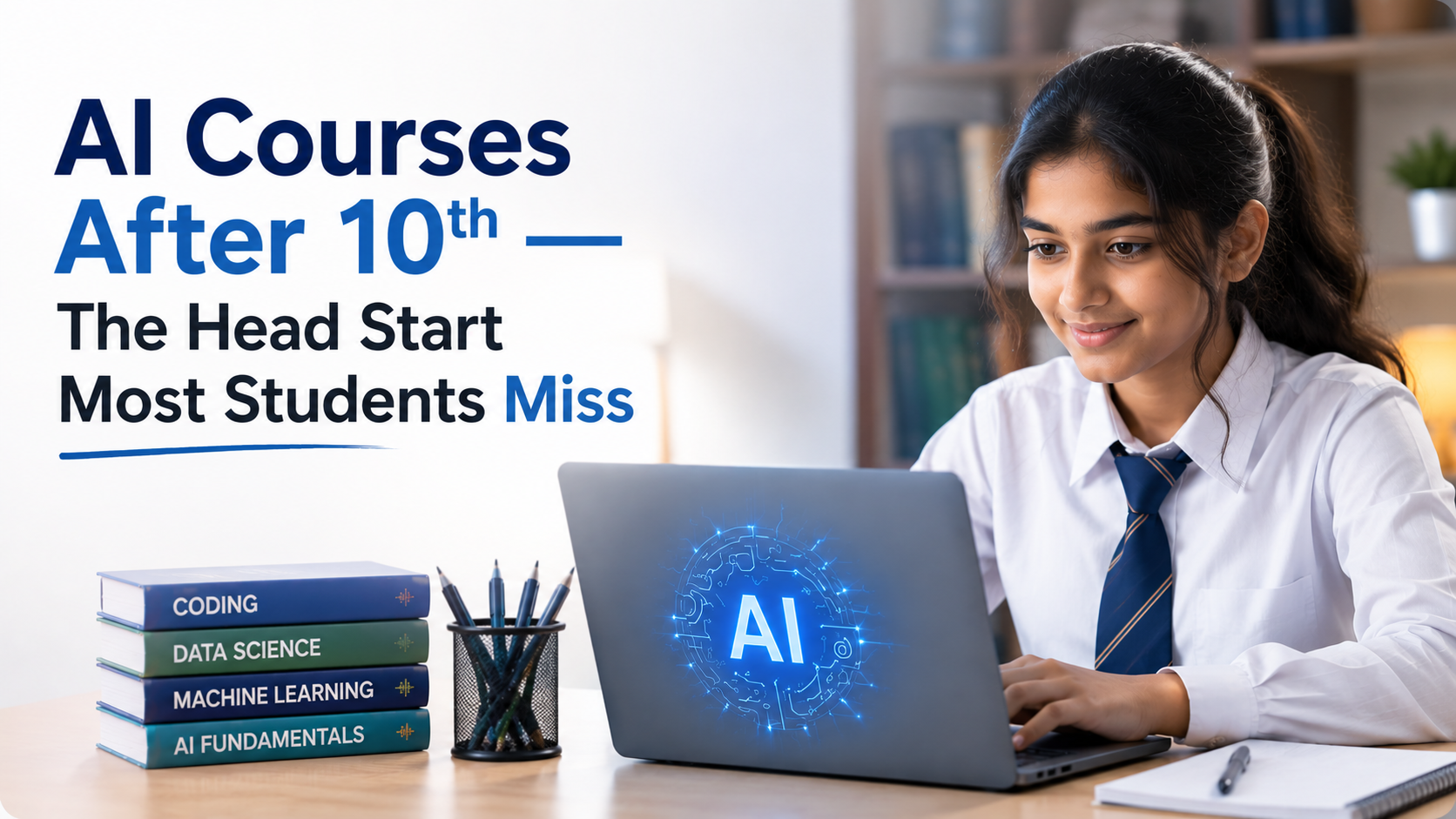
Don't wait for college to explore AI. The right AI courses after 10th can unlock opportunities most students don't even know exist — start early.
Rohan's mother didn't think much of it when her son chose AI as an elective in Class 9. It was one of those subjects — optional, slightly unfamiliar, not quite Science and not quite Computer Science. She figured it would look decent on a report card.
By Class 10, Rohan had built a working image recognition project. By the end of Class 11, he had a portfolio, a global certification, and three college counsellors in the US flagging his application.
She definitely thinks about it now.
The Crossroads Nobody Talks About
Board exams are over. The marks are in. And now comes the question every Class 10 parent and school knows is loaded: what next?
Science, Commerce, or Humanities is the obvious fork in the road. But there's a quieter, more consequential choice sitting right beside it — one that most families don't even realise they're making. It's the choice of whether your child starts building AI skills now, or waits.
Waiting used to be fine. You'd pick a stream, finish Class 12, get into college, and eventually encounter AI education in an engineering or data science degree. That pipeline still exists. But it's no longer the only one, and increasingly, it's not the fastest one either.
The window right after Class 10 is one of the most underrated opportunities in a student's academic journey. It's when they're old enough to grasp real concepts, young enough to build habits that stick, and — crucially — not yet locked into a college curriculum that controls their every hour.
What AI Courses After 10th Actually Look Like
This isn't about crash courses or YouTube playlists. The landscape of AI courses after 10th has matured significantly in the last two years.
Within the CBSE framework, students who opt for AI as a subject in Class 11 and 12 go well beyond what they covered in Classes 9 and 10. The senior secondary AI curriculum dives into advanced applications, real-world problem solving, specialised domains like Computer Vision and Natural Language Processing, and — importantly — career pathway preparation. It's not a soft elective anymore. It's a subject that can shape the next decade of a student's professional life.
Beyond the school curriculum, structured AI programmes designed for Classes 11 and 12 bridge a gap that textbooks simply can't fill. Think hands-on projects, mentorship from people who actually build AI systems at scale, and certifications that carry weight because they're backed by practitioners — not just institutions.
The Class 10 to 12 window is where the difference between a student who knows about AI and a student who can do something with AI gets made. That difference, as it turns out, is enormous.
Why Starting at 16 Beats Starting at 21 — Every Time
Here's something worth sitting with. The average B.Tech student in India encounters machine learning in their third year — at 20 or 21. By that point, a student who started building AI skills at 16 has a five-year head start. Not in age. In depth.
They've made mistakes with small projects when the stakes were low. They've iterated. They've built a portfolio with actual work in it. They've figured out what they're genuinely interested in — whether that's robotics, healthcare AI, NLP, or something else entirely — before they're committing to a specialisation.
And in a field where India's AI market is projected to touch USD 17 billion by 2027, that depth matters. Entry-level AI roles in India already pay between ₹6–12 LPA for freshers. Mid-career professionals with strong portfolios and real project experience regularly command ₹18–25 LPA. The gap between someone with a degree and someone with a degree plus five years of hands-on AI experience is not a small one.
But here's the more interesting point — it's not just about salaries. A student who has been building AI projects since Class 11 walks into college differently. They ask better questions. They find research opportunities faster. They're taken seriously by professors and recruiters in ways that students starting from zero simply aren't.
What Streams Are Compatible with AI After 10th?
One of the biggest misconceptions parents carry into this conversation is that AI after 10th is only for Science stream students. That's increasingly untrue.
Yes, if a student wants to eventually become an ML engineer or AI researcher, a PCM foundation helps. But the field of AI has expanded well beyond technical engineering roles. Today, AI touches business strategy, healthcare, content, law, design, and education — and professionals in all of those fields who understand AI are more valuable than those who don't.
A Commerce student who understands how AI-driven analytics works will make a better business analyst. A Humanities student who grasps NLP has an edge in media, communications, and policy work. The AI literacy built in Classes 11 and 12, through the right programme, translates across every stream.
The question isn't which stream is compatible with AI. The question is how deep do you want to go, and that depends on where the student's interests lie.
What Schools and Parents Should Be Asking Right Now
If you're a school principal, the conversation to have is this: does your Class 11–12 offering include AI in a way that goes beyond a textbook? Are your students building things — actual projects they can show to the world — or are they just reading chapters and writing exams?
The schools that are getting this right aren't waiting for CBSE to make it mandatory. They're partnering with programmes that bring mentorship, project-based learning, and global exposure into the classroom now. Their students are graduating with portfolios, not just mark sheets.
If you're a parent, the conversation to have with your child is simpler: what do you want to be able to do by the time you finish Class 12? If the answer involves technology, innovation, problem-solving, or building anything — AI courses after 10th aren't optional enrichment. They're the foundation.
The Last Two School Years Are More Important Than Most People Think
There's a line of thinking in Indian education that treats Classes 11 and 12 as purely a runway for board exams and entrance tests. Study hard, score well, get into a good college. That's the whole plan.
It's not a bad plan. But it's an incomplete one.
The students who will lead India's next wave of AI-driven industries — in healthcare, agriculture, finance, education, infrastructure — aren't going to be the ones who studied AI for the first time in second year of college. They're going to be the ones who started at 15 or 16, made their mistakes early, built something real, and arrived at college already knowing what they wanted to do with the technology.
Rohan's mother gets that now. More parents and schools are getting it every year.
The question is whether your student will be among the ones who started early — or the ones who looked back and wondered why they waited.
AI for Schools is Madhya Pradesh's first AI education initiative, partnering with 250+ schools to bring Silicon Valley mentorship, hands-on project learning, and globally recognised certifications to students from Class 3 to Class 12. Our Class 11–12 programme is specifically designed to prepare students for the AI-driven careers of tomorrow — through real projects, real mentors, and real skills.
Want to bring this to your school? Partner with Us