Artificial Intelligence CBSE Class 9 (2026) – Syllabus & Mark Distribution
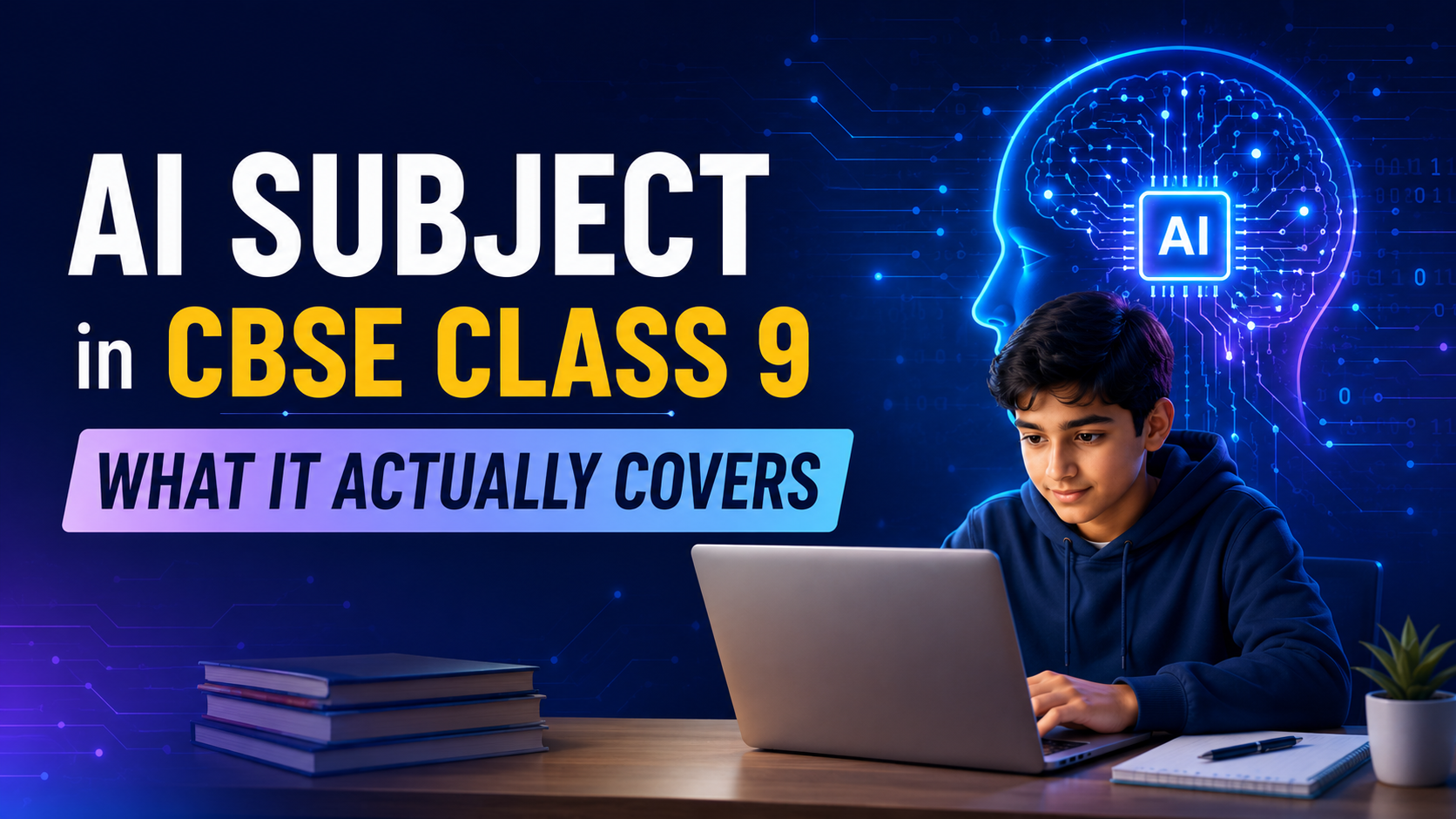
Explore what the CBSE Class 9 AI subject (Code 417) actually covers — from Python and Generative AI to data literacy, ethics, and hands-on AI projects that prepare students for the future.
Every year, thousands of parents and students search for “AI subject CBSE Class 9” and land on pages that either list the syllabus in bullet points or explain AI like it’s a Wikipedia entry. Neither helps much when you’re trying to figure out whether your child should take this subject, what they’ll actually learn, or why two students from two different schools can study the same syllabus and come out with completely different outcomes.
This blog tries to answer all of that — clearly, and without the fluff.
What Exactly Is This Subject?
The AI subject in CBSE Class 9 goes by the official name Artificial Intelligence, Subject Code 417. It sits under CBSE’s Department of Skill Education, which means it’s offered as a skill elective — students can pick it up alongside their five core subjects.
It’s not a theory paper about the history of robots. The curriculum, at least on paper, is genuinely practical. It’s built around making students what CBSE calls “AI-Ready” — meaning they understand how AI systems work, how data is used to train them, and how to think critically about what AI should and shouldn’t do.
The current version of the syllabus (2026–27) combines two modules — Inspire and Acquire — and runs for 210 hours across the academic year.
Is It Compulsory?
No. The AI subject in CBSE Class 9 is optional. Schools decide whether to offer it, and students decide whether to take it.
That said, NEP 2020 has been pushing schools toward integrating AI into the curriculum for a while now. Schools that offer it — and actually teach it well — are giving their students something real. Schools that don’t, or that add it to the timetable just to tick a box, are doing their students a disservice.
What Does the Syllabus Actually Cover?
The Class 9 AI syllabus is split into four parts. Here’s what each one contains.
Part A — Employability Skills
Before any AI concept is introduced, students spend 50 hours on employability skills — communication, self-management, ICT basics, entrepreneurship, and green skills. These carry 10 marks.
A lot of people dismiss this section as filler. It isn’t. The entire philosophy of the AI curriculum is that technical knowledge without the ability to communicate, collaborate, and think independently is incomplete. These skills are foundational.
Part B — Subject Specific Skills
This is where the real learning happens. 160 hours, 40 marks, five units.
Unit 1: AI Reflection, Project Cycle and Ethics
This is the largest unit, and rightly so. Students start by exploring the three core domains of AI — Data, Computer Vision, and Natural Language Processing — not by reading definitions, but by actually playing with AI tools. Rock Paper Scissors AI, Google’s Quick Draw, Semantris — these are the kinds of activities that make a 14-year-old genuinely curious about how machines learn.
The centrepiece of this unit is the AI Project Cycle — a six-step framework that mirrors how professional AI teams work:
• Problem Scoping
• Data Acquisition
• Data Exploration
• Modeling
• Evaluation
• Deployment
Students don’t just memorise these steps. They work through them by identifying a real problem in their community, filling out a 4Ws Problem Canvas, mapping stakeholders, and thinking through the data they’d need to solve it.
The ethics component deserves a mention here. Students explore AI Bias, AI Access, and the ethical dilemmas that come with building intelligent systems. They use tools like the Moral Machine to understand situations where AI has to make difficult choices — and they debate those choices in class.
Unit 2: Data Literacy
AI runs on data. This unit makes sure students understand that before they ever touch a model. They learn what data literacy means, why data privacy matters, how to collect and process data responsibly, and how to present it visually using tools like Tableau and Datawrapper.
The unit ends with a project — building an Interactive Data Dashboard — where students take real data and turn it into something someone can actually read and interpret.
Unit 3: Math for AI — Statistics and Probability
Possibly the most underrated unit in the entire curriculum. Statistics and Probability aren’t just classroom concepts here — students see exactly how they connect to how AI systems make predictions and decisions.
There’s an activity called Car Spotting where students physically go out, observe and record data about cars passing by, tabulate it, and then analyse it using basic statistical measures. It sounds simple. But it’s one of the most effective ways to show a student that data collection is not abstract.
Unit 4: Introduction to Generative AI
This is the newest addition to the Class 9 curriculum and probably the most relevant to the world students are actually growing up in. They learn what Generative AI is, how it differs from conventional AI, what GANs and VAEs and RNNs do at a conceptual level, and — crucially — what the ethical implications of creating AI-generated content are.
The activity where students try to guess which images are real and which are AI-generated is deceptively simple. By the end of it, students have a gut-level understanding of how convincing — and how dangerous — Generative AI can be.
Unit 5: Introduction to Python
One hour of theory, nine hours of practical, and a practical file of at least 15 programs. Python is introduced through gamified platforms like Code Combat, which removes the intimidation factor that stops most beginners cold.
Topics covered include variables, data types, operators, input/output functions, conditional statements, loops, and lists. The goal isn’t to turn a Class 9 student into a developer. It’s to make code feel like something they can actually do.
Part C — Practical Work
35 marks. Students maintain a practical file, write a practical exam (any 3 programs from a defined list), and appear for a Viva Voce. The practical carries more weight than most students expect.
Part D — Project Work
15 marks. Students choose one of three options — build an actual AI model using tools like Google’s Teachable Machine or Machine Learning for Kids, undertake an SDG-linked research project with data visualisation, visit an industry using AI and present a report, or maintain a portfolio of AI activities across the year.
How Is the Subject Marked?
Total marks: 100. Split as follows:
|
Component |
Marks |
|
Theory — Part A + Part B |
50 |
|
Practical Work — Part C |
35 |
|
Project Work — Part D |
15 |
|
Total |
100 |
More than half the marks come from what students build and do. That’s a deliberate design choice, and it means students who engage hands-on have a genuine advantage over those who only study for the written paper.
AI vs IT in Class 9 — Which One Should a Student Choose?
IT (Subject Code 402) covers digital documentation, spreadsheets, databases, and web design. It’s practical and useful, and it builds solid foundational digital skills.
AI (Subject Code 417) goes in a different direction entirely — it asks students to think about how technology makes decisions, what data means, how to build models, and what happens when AI gets things wrong.
For a student who wants to understand technology from the inside — not just use it — AI is the better choice. IT teaches students to use the tools of today. AI prepares them to build the tools of tomorrow.
The Gap Nobody Talks About
Here’s the honest part.
The CBSE Class 9 AI syllabus is genuinely well-designed. But a syllabus is only as good as its delivery.
Walk into most schools that offer the AI subject in Class 9, and here’s what you’re likely to find: a teacher who trained for a few days, a computer lab that may or may not have Python installed, and lessons that end up being dictation because there isn’t time — or confidence — to do the hands-on work.
Students sit through the year, clear the exam, and come out having never run a single Python program or built anything close to an AI model. They’ve technically studied the AI subject. They haven’t actually learned AI.
This gap is widest in Tier 2 and Tier 3 cities — exactly the places where quality AI education could make the biggest difference.
What Good Delivery Actually Looks Like
AI for Schools was built specifically to close this gap. Working across 250+ schools in India as a Google Professional Development Partner, the model is straightforward: take trained faculty into the school, use the existing computer lab, and deliver the curriculum the way it was meant to be taught — hands-on, project-based, and connected to real tools.
The curriculum is shaped by Silicon Valley mentors who track where AI is actually going, refined by educators from top universities, and delivered by a faculty network trained specifically for school-level AI instruction.
Students build actual AI models — not hypothetical ones. They go through the Project Cycle with a real problem, real data, and a real output. They get a Google-backed completion certificate that goes on their academic record. And they leave Class 9 with something most of their peers don’t have: a genuine understanding of what AI is and what it can do.
Frequently Asked Questions
What is the subject code for AI in CBSE Class 9?
Subject Code 417.
Is AI a scoring subject in Class 9?
Yes — and more so than students expect. With 50 marks in practicals and project work, students who engage genuinely tend to score well.
What software is needed?
Python, Anaconda Navigator, Intel OpenVINO tools, and Google Chrome. The CBSE curriculum also recommends Google Suite.
Can a student take AI as a 6th subject?
Yes. It can be taken as an additional skill elective alongside the five core subjects.
Does the syllabus include Generative AI?
Yes. The 2026–27 syllabus has a dedicated unit covering Generative AI types, tools, and ethical considerations.
What Python topics are in the Class 9 AI syllabus?
Variables, data types, operators, input/output functions, conditional statements (if/for/while), and Python Lists.
To Summarise
The AI subject in CBSE Class 9 is one of the better-designed additions to the school curriculum in recent years. It covers the AI Project Cycle, data literacy, math for AI, Generative AI, Python, and ethics — all in a single year, in a way that’s meant to be practical and student-led.
Whether that promise gets delivered depends entirely on how the school approaches it.
If you’re a parent, it’s worth asking your school not just whether they offer the AI subject — but how they teach it, what tools students use, and what students actually build by the end of the year.
If you’re a school, and you want to offer the CBSE Class 9 AI subject the way it was designed to be taught, AI for Schools is the right partner to make that happen.
AI for Schools delivers offline, hands-on AI education across 250+ schools in India in partnership with Google for Education. To bring the CBSE AI curriculum to life in your school, visit aiforschools.in