Artificial Intelligence for Kids in India — What Parents and Schools Actually Need to Know in 2026
India’s 2026–27 mandate makes AI compulsory from Class 3. Discover what AI for kids actually looks like and how parents and schools can close the gap.
Ask your child right now: what is artificial intelligence? Go on.
Siri? Robots? Something from a movie? That’s the answer most Indian kids give. And honestly, it’s the answer most Indian adults give too. The difference is that for this generation of children, that vagueness is about to cost something real.
In late 2025, India’s government made it official: AI is a compulsory school subject from Class 3 onwards, starting the 2026–27 academic year. Not an elective. Not an enrichment club that runs during the lunch break. A core subject, sitting alongside maths and English, with CBSE, NCERT, and IIT Madras all involved in building it out.
The debate about whether artificial intelligence for kids in India makes sense is over. That question has been answered. The one that matters now is simpler and more urgent: which children will arrive prepared, and which ones will encounter it cold?
Why Artificial Intelligence for Kids in India Is Being Pushed So Hard Right Now
The numbers make the case quickly. India’s AI market hit $17 billion in 2025. NITI Aayog projects up to 8 million new AI-linked jobs — though strip away the roles AI itself displaces, and that net gain only materialises for workers who actually have the right skills. A 2025 PwC study found AI-skilled workers earning 43% more on average. That gap isn’t closing. It’s getting wider.
The government’s logic isn’t complicated: if you want Indian children competing for those jobs, start teaching them now. Class 3 now.
What’s also pushing this is what’s happening in other countries while India’s been deliberating. China mandated a minimum of 8 hours of AI classes annually for primary school students in Beijing from September 2025. Singapore is training every teacher on AI by 2026. Hong Kong made it mandatory for junior secondary students back in 2023. India was behind. This rollout is an attempt to close that gap at scale, not incrementally.
The foundation already exists. Over 18,000 CBSE schools currently run a 15-hour AI module called SOAR for Classes 6 to 8. The 2026–27 mandate expands that downward to Class 3, makes it compulsory everywhere, and weaves it across subjects rather than keeping it siloed inside a single class period.
What “AI for Kids” Actually Looks Like in the Classroom
This is where most of the public conversation goes wrong. Artificial intelligence for students doesn’t mean sitting an eight-year-old in front of a laptop and asking them to write Python. That’s not the point, and it’s not what the curriculum is built around.
Good AI education at school level is closer to teaching children how to think than teaching them how to code. The government’s own framework calls it “AI for Public Good” — the expectation being that students understand how intelligent systems work, why they make the decisions they do, and how to use them responsibly. What that actually looks like varies considerably by age.
Classes 3 to 5 — Thinking Before Typing
Nobody is expecting a nine-year-old to train a model. At this stage the work is computational thinking — breaking problems into steps, recognising patterns, understanding sequences. These aren’t “tech skills” in the narrow sense. They’re thinking skills that carry over into maths, writing, decision-making, and pretty much everything else. AI gives those skills a concrete and interesting context rather than making them feel abstract.
Classes 6 to 8 — Seeing How It Actually Works
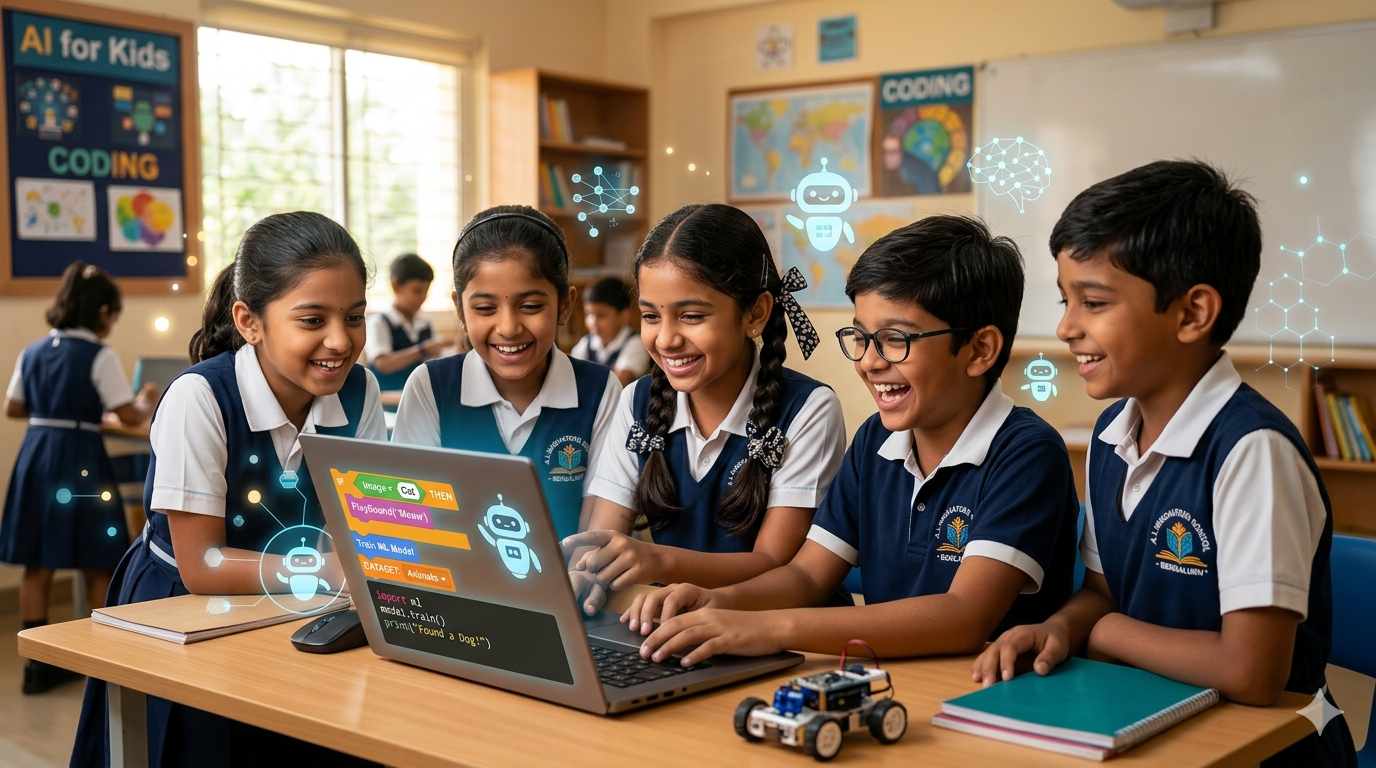
This is where things get specific. Students explore how machine learning functions, not in theory but through actual projects. A student might collect images of two different objects, label them, and watch a model learn to tell them apart. Another might look at how a recommendation system decides what to put in front of you. The key shift at this level: by the end, students understand that AI doesn’t think the way humans do. It recognises patterns in data. That distinction matters enormously — and most adults, including educated ones, still haven’t fully grasped it.
Classes 9 to 12 — Building Things That Matter
Secondary students work on applications with real-world relevance: AI tools for agriculture, healthcare, environment, education. They build portfolios. They earn certifications that actually mean something beyond the school’s notice board. They start to see, concretely, what a career in AI could look like — which is something most school curricula don’t even gesture toward.
The Part of This Story Nobody in the Press Releases Is Talking About
The AI education push is the right call. But there’s a gap between what a policy document announces and what actually happens in a classroom, and it’s bigger than most people are admitting.
Roughly half of India’s schools don’t have the digital infrastructure to support any of this. No reliable internet. No devices. In some cases, no reliable electricity. Surveys from 2025 put the share of teachers who feel ready to teach AI at around 15%. Bihar, Uttar Pradesh, and rural Madhya Pradesh — exactly the states where this intervention matters most — are also the ones where implementation is most likely to stall.
The government’s answer to the infrastructure problem is “unplugged learning”: teaching AI concepts through physical activities and games that don’t need devices. It’s clever, genuinely. But it’s a workaround, not a long-term fix.
The real fix is programmes that walk into schools with the curriculum, the training, the tools, and the mentorship already built — so a school in Bhopal or Jabalpur doesn’t have to figure that entire out from scratch while also managing a hundred other things. That’s the gap AI for Schools was specifically built to fill. India’s first AI education initiative in Madhya Pradesh, now working with over 250 schools nationally, it started precisely because someone recognised that the mandate would arrive before most schools were anywhere close to ready for it.
What to Actually Look for in an AI Programme for School Students
There is a lot of AI content for kids right now that looks credible in a brochure and doesn’t teach children much of anything. Here’s what separates programmes that work from ones that don’t:
• Does the child build something? Project-based learning isn’t a pedagogical preference — it’s the only real indicator that a child has understood something well enough to apply it. Watching someone explain AI and actually building something with it are completely different experiences. If a programme can’t show you what students have made, that’s a problem.
• Who is actually doing the teaching? A trainer who’s done a weekend AI course is not equivalent to someone who has built AI systems professionally. At higher grade levels especially, the quality of mentorship makes a measurable difference to what students come away with.
• Is it aligned with NEP 2020 and the CBSE AI framework? If what a programme teaches has no connection to the government’s rollout, students end up juggling two parallel streams that don’t reinforce each other. The best programmes are designed to integrate with, not sit alongside, what schools are required to teach.
• Do the certifications mean anything outside the programme? Certificates from platforms nobody has heard of carry almost no weight. Look for credentials backed by institutions or partnerships with genuine global recognition.
• Has it actually worked in a city like yours? Many good-looking AI programmes are metro-centric by design and by infrastructure. If you’re in a smaller city, verify that the programme has real experience operating there — not just a line on their website saying they cover all of India.
AI for Schools holds up on all five. Curriculum from Class 3 to Class 12. Mentors from Google AI, OpenAI, Meta, and Apple. Internationally recognised certifications. And it was built from the start for schools in Madhya Pradesh and similar Tier 2 and Tier 3 settings — not retrofitted after the fact.
A Note for School Administrators
The schools parents compete to enroll their children in are not the ones that checked every government box on time. They’re the ones that spotted where things were heading and moved before they were required to.
The 2026–27 AI mandate is a floor. Schools treating it as a ceiling — doing the minimum required to say they’ve complied — will produce students with the minimum level of AI understanding. That’s not a differentiator. It’s a baseline that every school in the country will eventually meet.
In 2026, parents evaluating schools aren’t just asking “do you have smart boards?” They’re asking how the school is preparing their child for what the next decade actually looks like. A credible, structured AI programme — one you can demonstrate concretely, not just mention in an admissions booklet — is already becoming a meaningful point of difference between schools that families choose and schools they settle for.
AI for Schools has worked with more than 250 schools through this transition. If yours hasn’t started yet, it’s worth a conversation sooner rather than later.
The Bottom Line
Artificial intelligence for kids in India isn’t a trend with a shelf life. It’s not something to revisit when things settle down or when the curriculum officially kicks in at your child’s school. It is the foundational literacy of the next decade, and the children who get genuine early exposure — not a checkbox module, but real mentorship, real projects, real credentials — will carry that advantage in ways that compound for years.
The government has made it mandatory. What parents and schools decide to do beyond the minimum is what actually determines which children are ready.
Don’t wait for the curriculum to catch up to your child. Start now.
FAQs: Artificial Intelligence for Kids in India
At what age should my child start learning AI in India?
The government’s baseline is Class 3, which is roughly age 8. But the conceptual groundwork for AI — computational thinking, pattern recognition, problem decomposition — can begin meaningfully at age 6 or 7. Starting before the school curriculum kicks in gives children a head start that isn’t just about knowing more. It’s about arriving comfortable with something their peers will encounter for the first time.
My child has never coded. Can they still learn artificial intelligence?
Yes — and this is the question worth pushing back on a little. The assumption that AI learning requires coding first is exactly backwards. AI education at school level starts with understanding: how machines make decisions, what data is, why patterns matter. Block-based visual tools come before any text-based programming. Python comes much later, and not every student needs to go that far.
Most children who describe themselves as “not tech-savvy” discover that AI education, when it’s taught well, is nothing like the computer classes that put them off. The self-assessment is usually wrong.
What exactly did the government announce about AI in schools?
In October 2025, India’s Ministry of Education confirmed that AI and Computational Thinking will be compulsory from Class 3 in all CBSE, KVS, and NVS schools from 2026–27. IIT Madras leads the curriculum. Teacher training runs through the NISHTHA programme. The Union Budget 2025–26 also set aside ₹500 crore for a Centre of Excellence in AI for Education.
How is AI for Schools different from buying an AI app or online course for my child?
An app or online course gives a child content. Something to watch or click through. AI for Schools gives a child a structured learning pathway with mentorship from professionals who have built real AI systems at Google AI, OpenAI, Meta, and Apple — alongside hands-on project work and internationally recognised certifications.
The programme runs from Class 3 to Class 12 and was built specifically for schools in Tier 2 and Tier 3 Indian cities, not designed for metro schools and then made available elsewhere. A child who has completed a structured project under expert guidance and a child who has watched AI explainer videos are not in the same position. Not even close.
Will learning AI hurt my child’s performance in regular subjects?
No. The evidence consistently points the other way. Computational thinking — the mental skill that sits at the centre of AI education — builds logical reasoning and mathematical thinking as side effects. The government’s own curriculum design treats AI as a cross-subject capability, not a standalone add-on competing for the same brain space as maths homework. Children learning AI concepts are also sharpening the thinking that helps in science, in problem-solving, and in approaching unfamiliar situations with less anxiety.
How can my school in a smaller city partner with AI for Schools?
Reach out directly. AI for Schools is based in Bhopal and works with schools across Madhya Pradesh and nationally — including in cities that most edtech programmes consider too small to bother with. Call +91 9810450465, email Jai@aiforschools.in, or visit the office at The DM Tower, Danish Kunj, Kolar Road, Bhopal — 462039. The team will walk you through what a partnership actually looks like for your school’s specific stage and class range.
Explore structured artificial intelligence for kids in India with AI for Schools — hands-on, offline programmes running in 250+ schools, backed by Google for Education. Visit aiforschools.in or call +91 9810450465.