Schools That Teach AI — The Head Start Most Students Miss
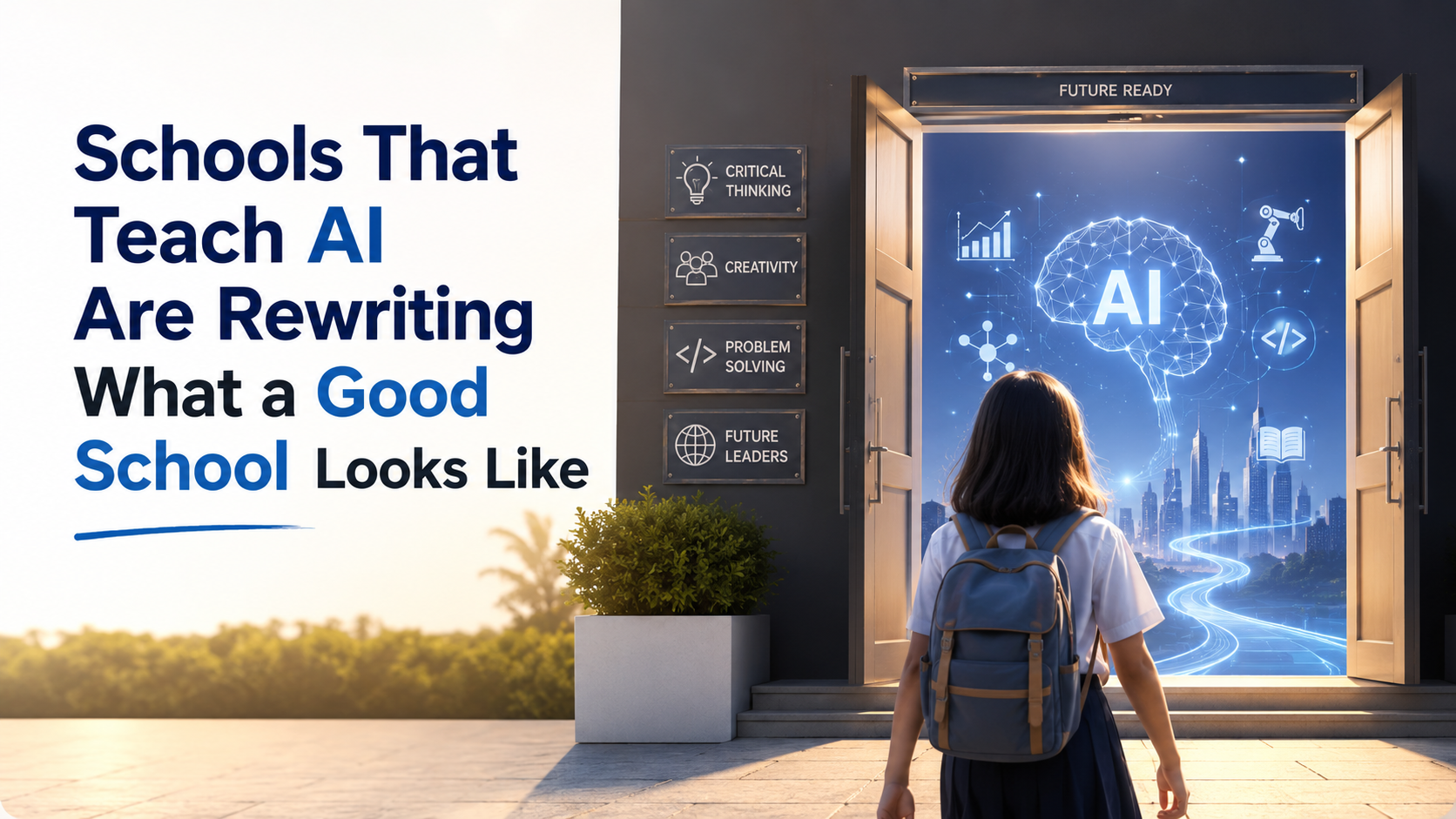
What makes a school truly great in 2026? Increasingly, it's AI. Discover how schools that teach AI are reshaping expectations for students and parents alike.
Meera had done everything right when shortlisting schools for her daughter's Class 6 admission. She visited campuses, checked board results, inspected labs, asked about extracurriculars. The usual checklist.
Then a friend asked her a question she hadn't considered: "Does the school teach AI?"
Meera paused. She wasn't sure what that even meant — or why it should matter alongside infrastructure and academics. But the more she looked into it, the more she realised that question was quietly separating forward-thinking schools from the rest. Not just in metros. In cities like Bhopal, Indore, and Nagpur too.
Why "Does Your School Teach AI?" Is Now a Fair Question
For most of India's educational history, the markers of a good school were predictable. Board results. Faculty credentials. Sports facilities. Maybe a robotics club or a debate team if you were lucky.
That list is being rewritten.
The Ministry of Education has formally announced that AI and Computational Thinking will be introduced from Grade 3 onwards, starting from the 2026–27 academic session, aligned with NEP 2020 and NCF SE 2023. Teacher training is being rolled out through NISHTHA. Curriculum materials were targeted for completion by December 2025. This is no longer a proposal on paper — it's an active rollout.
But here's what that announcement really signals: the schools that are already teaching AI aren't ahead of a trend. They're ahead of a mandate. And the gap between them and schools that haven't started yet is widening every month.
What It Actually Looks Like When a School Teaches AI
This is where a lot of parents and even teachers get confused. "Teaching AI" sounds like something that happens in engineering colleges — whiteboards covered in algorithms, Python code, complex mathematics.
That's not what it looks like at the school level. Not even close.
In schools genuinely integrating AI education, students build simple machine learning models, experiment with chatbots, and explore data science concepts through age-appropriate applications — making AI a hands-on practice rather than an abstract topic. A Class 7 student might train a model to sort images. A Class 9 student might build a basic recommendation system. A Class 11 student might be working on a portfolio project that showcases actual AI tools they've designed.
Schools serious about this also look different from the inside — they have structured labs and tools, collaboration with trained and enthusiastic faculty, and students who can demonstrate their learning rather than just describe it.
That last part matters more than most parents realise. A school where students can show you something they built is categorically different from one where they can only recite definitions from a textbook.
What Separates Schools That Teach AI from Schools That Just Talk About It
By now, there are broadly three kinds of schools in India when it comes to AI education.
The first kind has a smart board, maybe a coding elective, and a brochure that mentions "21st century skills" somewhere in the fine print. They're technically not wrong — but they're not really teaching AI either.
The second kind has genuinely integrated AI as a subject — CBSE code 417 or 843, a dedicated teacher, some structured content. This is meaningful progress. But the subject often remains siloed, disconnected from the rest of learning, and dependent on a single motivated faculty member.
The third kind — the rarest, and the most valuable — has made AI education systemic by collaborating with AI education companies. Students build projects across the year, not just during AI class. The Union Budget 2025–26 even allocated ₹500 crore for a Centre of Excellence in AI for Education, signalling that the government understands this systemic integration is where the real value lies.
When parents ask "does this school teach AI?” they should really be asking which of these three categories their school falls into.
For School Principals: The Window Is Closing Faster Than It Looks
Here's something worth saying plainly to school leaders reading this.
CBSE has already introduced AI as an elective subject in Class 9 since 2019–20 and in Class 11 since 2020–21, and has also collaborated with IBM to integrate AI curriculum in 200 schools across India. CISCE has added robotics and AI to its curriculum beginning in the 2025–26 academic year. The boards are moving. The government is moving. Parents are starting to ask questions they weren't asking three years ago.
Schools that begin implementing AI education properly now — not as a checkbox but as a genuine curricular shift — will have a significant advantage when the 2026–27 mandate kicks in. They'll have student cohorts who already have experience. They'll have figured out the rough edges of implementation without doing it in a panic.
Schools that wait will be implementing on a deadline, with students who are starting from zero. That's not an impossible situation — but it's a much harder one.
What Parents Should Look for When Evaluating Schools That Teach AI
If you're a parent in the middle of this decision, here's a practical frame:
Ask for student work, not just syllabi. Any school worth its claim around AI education should be able to show you actual projects that students have built — not just course outlines and certificate programmes listed in the prospectus.
And ask about mentorship. One of the most significant differentiators emerging between schools is access to practitioners — people who work in AI professionally and bring that real-world lens into the classroom. Textbooks and dedicated teachers are the floor. Mentors who've built AI systems at scale are the ceiling most schools haven't reached yet.
The School Your Child Attends Is Making a Choice Too
Meera eventually found her answer. Not by looking harder at infrastructure, but by asking different questions. She found a school that had structured AI learning from Class 6, mentors who were trained and enthusiastic, and students in Class 8 who could walk her through projects they'd built themselves.
Her daughter starts there in June.
The shift happening in Indian education right now isn't subtle. Artificial intelligence in school is meant to position students as creators, not just consumers, in a tech-driven world — and its success depends on thoughtful implementation, strong teacher support, and a balanced approach that nurtures both tech skills and human values.
Schools that understand this are becoming a different category of institution entirely. The question for every parent, teacher, and school leader is the same one Meera's friend asked her: does your school teach AI?
And more importantly — does it teach it well?
AI for Schools is Madhya Pradesh's first dedicated AI education initiative, currently partnering with 250+ schools across the region. We bring Silicon Valley mentorship, structured project-based learning, and globally recognised certifications directly into school classrooms — from Class 3 to Class 12. If you're looking for a partner who can help your school genuinely teach AI — not just put it in the brochure — let's talk.