The AI Tools Students Are Actually Using to Study — And What Schools Should Think About That
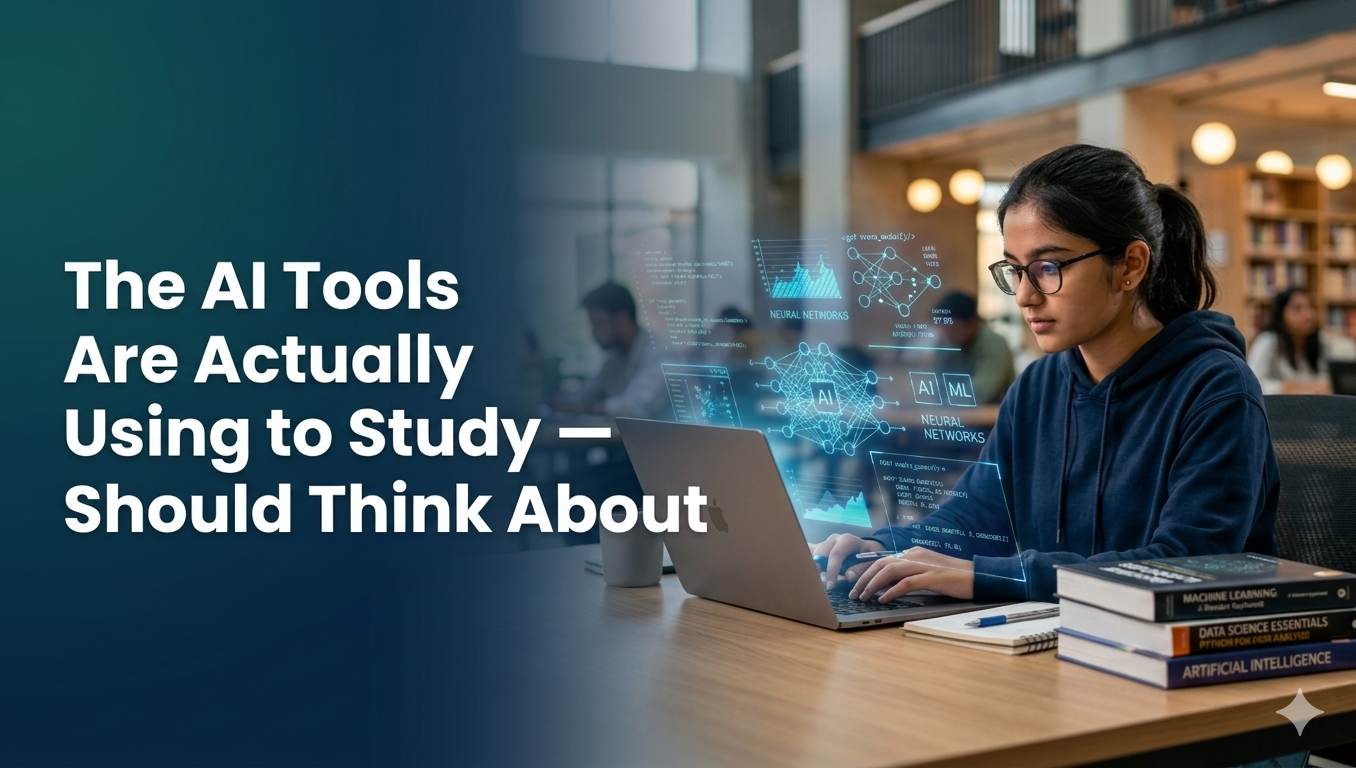
The blog explores how Indian students (particularly in Classes 9–12) are rapidly adopting AI tools like ChatGPT, Quizlet, Photomath, and Notion AI to manage heavier workloads.
Somewhere between Class 9 and Class 12, most Indian students discover that the way they were taught to study — read, underline, re-read, repeat — doesn't really scale. The syllabus gets heavier. The chapters get longer. And underlining the same paragraph for the third time starts to feel less like studying and more like a performance of studying.
So they find shortcuts. That's always been true. What's changed is what the shortcuts look like now.
AI tools are already in the study routine. The question is how.
Ask any group of Class 10 or 11 students and a decent chunk of them will tell you they've used ChatGPT to explain a concept, Quizlet's AI features to make flashcards, or Photomath to check where they went wrong in a problem. This isn't a future thing. It's already happening, mostly without any adult guidance on how to do it well.
Which is fine, mostly. A student who uses an AI tool to re-explain the water cycle in simpler language isn't cheating — they're doing what a good tutor would do, except the tutor is free and available at midnight.
But there's a wide gap between using AI to understand something and using AI to avoid understanding it. That gap is where things get interesting.
What these tools are actually good at
Let's be specific, because "AI tools help you study better" is the kind of sentence that sounds meaningful and says nothing.
Conversational AI — ChatGPT, Gemini, Claude — is genuinely useful when you ask it the right kind of question. Not "what is osmosis" (just Google that). More like "I understand that water moves from high concentration to low concentration, but I don't get why that means the cell swells up. Can you walk me through it?" That kind of back-and-forth, where the student is already halfway there and just needs the last piece to click — AI handles that well.
Flashcard tools with AI features, like Quizlet, are useful for subjects that are heavy on memorisation. History dates. Geography facts. Biology terminology. You paste in your notes, it generates a test. The research on active recall is pretty unambiguous — testing yourself repeatedly beats re-reading by a significant margin. AI just makes setting that up faster.
For writing and structuring ideas, tools like Notion AI can help a student who has thoughts but struggles to organise them. Useful for projects, useful for essay prep, useful when your brain has the ingredients but not the recipe.
Maths is its own thing. Photomath and Wolfram Alpha will show you a worked solution step by step. The obvious risk is that students copy without understanding. The less obvious benefit is that seeing the method laid out clearly — especially for students who got lost midway through a problem — can be more useful than a textbook explanation that assumes you followed every step.
Here's the part most articles skip
None of this is the same as understanding AI.
Using an AI tool to summarise your History notes is a bit like using a calculator in Maths. Useful. Time-saving. Fine. But it doesn't mean you understand how the calculator works, and it definitely doesn't mean you could build one.
India is heading into a decade where AI literacy — not just AI usage — is going to matter enormously. The difference between a student who knows which tools to open and a student who understands why those tools work the way they do is not a small difference. It's the difference between someone who uses technology and someone who shapes it.
That's not a criticism of students who use AI to study. It's a gap that schools need to close.
When students learn AI as a subject — actually understand what machine learning is, why a model gives certain outputs, how data shapes what an AI can and can't do — they start interacting with these tools completely differently. They notice errors. They ask better questions. They don't take the output at face value.
A Class 9 student who has spent time understanding how AI systems are trained will use ChatGPT more critically than one who hasn't. That critical relationship with the technology is worth more than any individual study session.
For parents who aren't sure what to make of all this
If your child is using AI tools to study, the most useful thing you can do isn't to restrict it — it's to ask questions about it. What did it tell you? Did that make sense? Was it right?
That conversation, done regularly, does more than any content filter.
And if you're wondering whether their school is preparing them to understand AI — not just use it — that's a fair question to ask the school directly. NEP 2020 made it clear that AI belongs in the curriculum. The schools that took that seriously early on are already seeing the difference in how their students think.
The tools are accessible to everyone. The understanding is still unevenly distributed. That's the gap worth closing.
AI for Schools works with 250+ schools across India — from Class 3 to Class 12 — bringing hands-on AI education built around real projects, Silicon Valley mentorship, and certifications that mean something. If you want your school involved, start here.