The Best AI Learning Platform for Students in India Isn’t an App — It’s a Program
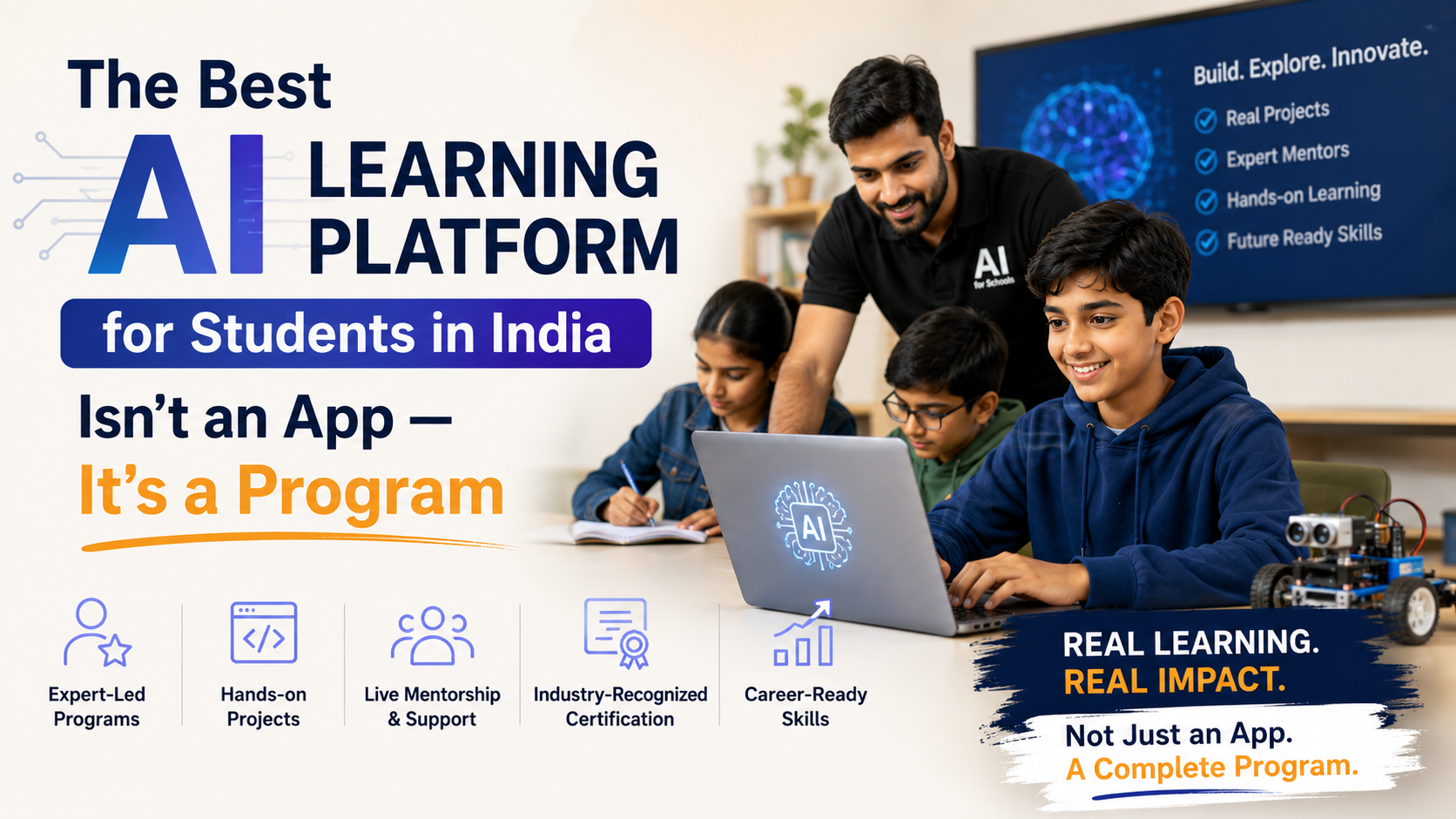
Discover why the best AI learning platform for students in India isn’t just another app — it’s a structured, hands-on program that combines mentorship, real projects, and practical AI education for future-ready skills.
Ask any parent who has started looking into AI education for their child and they’ll tell you the same thing — there’s no shortage of options. AI-driven learning platforms for students have multiplied over the last few years, and many of them are genuinely impressive in what they offer. The real question isn’t whether these platforms exist. It’s whether a platform, by itself, is the right model for how school-age students in India actually learn best.
That question leads somewhere most people don’t expect.
Learning AI Is Different From Learning Most Other Things
There’s something about AI as a subject that makes it uniquely difficult to learn in isolation. It isn’t like picking up a language or working through a math curriculum, where the path is largely linear and self-directed practice produces measurable progress.
AI requires a student to think about problems before thinking about solutions. It requires them to question data, sit with ambiguity, make decisions that don’t have one right answer, and then defend those decisions. That kind of thinking develops fastest in an environment where there’s a teacher asking the right questions, classmates working through the same problem from different angles, and a structured outcome that the student has to actually produce and present.
This is why the best AI learning platform for students in India — when you dig past the search results and think about what learning actually looks like — ends up being a program built around a classroom, not a screen.
What “AI-Driven Learning” Should Actually Mean for Students
The phrase “AI-driven learning platform for students” gets used in a lot of different ways. Sometimes it means a platform that uses AI to personalise what content a student sees next. Sometimes it means a platform that teaches students about AI as a subject. These are very different things, and it’s worth being clear about which one actually prepares a student for the future.
A student who has been served personalised content by an algorithm has experienced AI. A student who has scoped a real problem, collected data, built a model, evaluated its accuracy, and presented their findings has understood AI — and more importantly, has started thinking like someone who can work with it professionally.
The second kind of learning doesn’t happen passively. It happens in a room, with a teacher, over the course of a structured program that builds week on week.
That’s the model that produces students who can articulate what they built, why they built it, and what they’d do differently.
The School Environment Is an Asset, Not a Constraint
One of the assumptions built into most conversations about AI-driven learning platforms for students is that the school is a limitation — that the most cutting-edge AI learning happens outside the classroom, on platforms that can move faster than the curriculum.
That assumption is worth questioning.
Schools have something no platform can replicate: a captive environment, a teacher-student relationship that already exists, a peer group that the student is comfortable with, and an institutional structure that creates accountability. When AI education is delivered inside that environment rather than around it, something changes. Students show up. They participate. They complete projects. They take the subject seriously because it’s being treated seriously.
The most effective AI learning programs in India are the ones that work with this reality rather than against it — that bring the curriculum into schools, work within existing timetables, use computer labs that schools already have, and produce outcomes that live on a student’s academic record rather than a platform profile.
Why NEP 2020 Points Schools in This Direction
India’s National Education Policy 2020 made something clear that a lot of schools are still working out how to act on: AI education isn’t optional anymore. The policy frames it as a core part of the shift toward skill-based, application-oriented learning that every school is expected to make.
What NEP 2020 describes — and what CBSE’s AI curriculum under Subject Code 417 operationalises — is a model of learning that is hands-on, project-linked, and tied to demonstrable outcomes. Students don’t just study AI concepts. They go through an AI Project Cycle. They scope problems, acquire and explore data, build and evaluate models, and deploy solutions. They write Python. They engage with Generative AI. They think about ethics.
This is a rich, demanding curriculum. Delivering it well requires trained educators, a structured program, and real tools.
The best AI learning platform for students in India, from a policy standpoint, is the one that helps schools actually implement what NEP 2020 and the CBSE AI curriculum are asking for. And that’s a program question, not a platform question.
What Genuine AI Education Produces
It’s worth being concrete about what a student who has gone through a well-delivered AI program actually walks away with — because this is the standard against which any AI-driven learning platform for students should be measured.
They can explain what the AI Project Cycle is and walk through the steps they took in their own project. They have a working model they built — not a pre-built one they modified, but one they designed from a problem they identified. They have a portfolio of work that documents their thinking at each stage. They have a certificate that represents completion of a structured, assessed program. And they have a basic fluency in Python that gives them a foundation to build on.
These outcomes don’t come from passive content consumption. They come from being in a classroom, being challenged by a teacher who knows the subject, and being held to a standard that has real consequences — like a final assessment and a project presentation.
That’s what the best AI learning platform in India needs to produce. And it’s a high bar.
How AI for Schools Is Built Around This Model
AI for Schools operates on a straightforward premise: the most effective place to deliver AI education to school students in India is inside their school, not around it.
The program is delivered offline, in person, by trained faculty who come directly to the school and works within the existing timetable using the school’s own computer lab. There’s no new infrastructure required. There’s a teacher in the room, a curriculum that maps to the CBSE AI syllabus, and a program structure that builds from one session to the next.
The curriculum has been shaped by Silicon Valley AI mentors, refined by educators from top universities, and delivered by faculty trained specifically for school-level AI instruction. Students go through the AI Project Cycle with real problems. They build actual AI models using tools like Google’s Teachable Machine. They write Python. They work with data. They engage with Generative AI and think about what it means to use it responsibly.
At the end, they receive a completion certificate backed by Google for Education — a credential that carries genuine academic and professional weight.
The program runs across 250+ partner schools in India, with a particular focus on making quality AI education accessible in Tier 2 and Tier 3 cities. For AI for Schools, that accessibility isn’t a side note — it’s the core of the mission.
The Certification Question
When evaluating any AI-driven learning platform for students, the certification it offers is worth looking at carefully — not because a certificate is the point of education, but because it’s a proxy for the rigour of the program behind it.
A certificate that reflects completion of a structured, assessed, in-person program — one backed by a credible institutional partner — tells a college admissions officer or a future employer something meaningful. It says a student engaged with a demanding subject, produced real work, and was assessed by someone qualified to evaluate it.
Students who complete AI for Schools receive a certificate backed by Google’s Professional Development Partner credential. For a Class 9 or Class 10 student building their academic profile, that’s the kind of recognition that matters when it counts.
Questions Worth Asking Before Choosing an AI Learning Program
Whether you’re a parent looking for the right AI-driven learning platform for your child, or a school administrator evaluating the best AI learning platform in India for your institution, a few questions cut through most of the noise.
Does this program require students to build something from scratch, or do they work through pre-designed exercises? Is there a qualified, trained teacher involved in delivery? Is the curriculum mapped to CBSE or NEP 2020 frameworks? Does the certificate represent a structured, assessed program? And does the program come to the school, or does the school have to adapt around the program?
These are the questions that separate programs producing skilled, confident students from ones producing students who have been exposed to AI content — which is a different thing entirely.
The Bigger Picture
India is at an interesting moment with AI education. Awareness is high. Intent is strong — from CBSE, from NEP 2020, from schools, from parents. What’s still catching up is delivery.
The conversation about the best AI learning platform for students in India is really a conversation about what kind of delivery model produces the outcomes that all this policy intent is actually pointing toward. And that conversation, when it’s honest, keeps coming back to the same answer: structured, in-school, teacher-led, project-based, and assessed.
That’s what AI for Schools has built. And it’s why, when parents and school administrators who have done their research are asked what they found, more and more of them are pointing not to an app — but to a program.
AI for Schools is a Google Professional Development Partner delivering offline, hands-on AI education programs across 250+ schools in India. To bring structured AI learning to your school, visit aiforschools.in.